
This post was originally published in [2021] and has been fully updated for 2026 with new data and tools.
You click “Swap,” the window pops up, and then you see it: that dreaded red text.
It’s frustrating when you have money in your wallet but can’t move it.
If you’re stuck right now, don’t panic—this guide shows you exactly how to fix Metamask insufficient funds for gas without overpaying.
I’m using Metamask mostly for a crypto card game, and was wondering why the fees are so high. Also, what makes up gas fees, and why does the Metamask fox look like a serial killer?
Keep reading, and I’ll also share 3 tips to lower your fees using Metamask, how fees can get lower in the future, and what determines the gas prices.
Is Gas Cheap Right Now?
Current Ethereum Gas levels are constantly changing.
Check Real-Time Gas PricesPro Tip: Fees are usually lowest between 1 AM and 5 AM UTC.
How to fix Metamask’s insufficient funds for gas
That red “insufficient funds for gas” thing is annoying.
Sometimes it just means you’re holding the wrong cash for the wrong highway. Or the wallet’s math is off.
- Metamask requires the native token you are using to pay for gas.
Just send a small amount $5-$10, to your wallet.
- Lower the bid
Sometimes Metamask overestimates how much gas is needed, causing this error. You can lower the bid.
On the transaction confirmation screen, click the market icon, then advanced, then slightly lower the Max Fee (Gwei).
There are some tools in this post that can help show the current low gwei price.
- Pay with gas station
On the confirmation screen, look for “pay fee with (toke). If available, Metamask will handle the swap in the background.
- Send Max button glitch
There is a send max button that calculates everything and the fee. If it glitches, you can try manual subtraction, and this could fix it.
- Clear the cookies or jam
Like clearing cookies works on websites, you can do something similar on Metamask.
Settings, then advanced, Reset account. This clears your local transaction history so Metamask can start fresh.
| Network / Blockchain | Native Gas Token | Role of the Token |
| Ethereum Mainnet | ETH | Required for all Layer 1 transactions. |
| BNB Smart Chain | BNB | Powers the BEP-20 ecosystem. |
| Polygon PoS | POL | Rebranded from MATIC in late 2024. |
| Solana | SOL | Required for the high-speed SOL network. |
| Base (Coinbase) | ETH | Uses ETH, but specifically “ETH on Base.” |
| Arbitrum One | ETH | Uses ETH, but specifically “ETH on Arbitrum.” |
| Avalanche C-Chain | AVAX | Powers the EVM-compatible C-Chain. |
| Optimism (OP Mainnet) | ETH | Part of the Superchain; uses ETH for gas. |
| Linea | ETH | Consensys’ L2; uses ETH for gas. |
| Tron | TRX | Required for USDT (TRC-20) transfers. |
Is MetaMask Still the Best Ethereum Wallet for Beginners in 2026?
Metamask is a wallet that stores Ethereum and can NOT be used for other cryptocurrencies. It’s also a browser extension for Chrome, Firefox, Brave, and it can be used on Android phones.
The goal of Metamask is “to make Ethereum as easy to use for as many people as possible.”
This is true because, before Metamask, someone would have to download the entire blockchain. I have not downloaded the Ethereum blockchain, but I have for Defi Chain, another project, and it’s a royal pain in the ass.
You might be wondering what about a private key for your coins. Metamask doesn’t have a private key; your coins are stored on your browser, not on any remote servers.
This is similar to an exchange. If you are worried about security, then there is an option to attach a hardware wallet to Metamask.
Lastly, the mascot of Metamask is creepy, isn’t it? Just look at how it follows your cursor around just like a killer from a horror movie.
It even tries to look at your password.
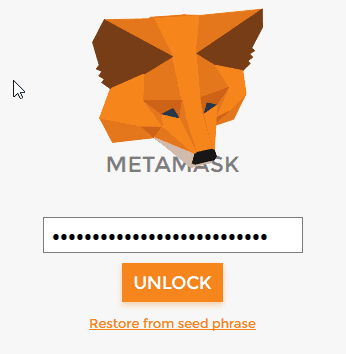
The one good thing about the mascot for Metamask is that it’s different.
I don’t know of any other mascot that will follow your cursor around.
Oh, and Metamask charges a flat service fee of 0.875 percent for each transaction. The reason there is a fee is that Metamask provides a service. It’s also used to support ongoing Metamask development.
The next part of the fee for making a transaction on Ethereum is gas prices. The gas prices are a big reason that making a transaction happen on Ethereum can be SO expensive.
Ethereum Gas Fees Explained: Why Do You Need ETH to Move Your Money?
Gas is the unit that measures the amount of computerized effort to make a transaction happen on the Ethereum blockchain.
In Bitcoin’s blockchain, each block has a limit of 1 Megabyte.
This works because all Bitcoin does is confirm transactions, and it’s simple.
There is only so much room in a Bitcoin block, so to add your transaction to it, there is a fee. This fee is based on the supply and demand of how many people are doing business with Bitcoin.
Ethereum is MORE complex, and each block doesn’t have a maximum size but has a maximum gas. Unlike Bitcoin, Ethereum’s block limit can change.
When Ethereum was first created, the limit was 5,000 gas per block.
Now the limit is 12.5 million gas per block. You might be wondering why not just increase the size of each block to reduce fees and make transactions faster.
The problem with increasing the size of each block is that it increases the hardware requirements to run a node.
This causes other problems, such as growing the blockchain, and the network becomes less decentralized because it’s harder to run a node.
In the simplest terms, the reason gas prices are high on Ethereum is that people are clogging up the network. Due to the interest in NFT’s, Defi, and more interest in the coin.
What determines the price of gas is people outbidding each other to make a transaction happen on the Ethereum network.
If there were no interest in Ethereum, nobody would try to outbid you, and the fees would be MUCH lower.
You might be wondering if the price of Ethereum rises, does that increase the price of gas? The answer is No.
The only relationship between the price and gas fees is the amount of interest more people have in Ethereum.
As I’m writing this, NFT’s are the most popular thing in the crypto world, and there are even 2 games I know of where you can earn money collecting NFT’s to sell on the Ethereum network.
These 2 games are Gods Unchained and Axie Infinity.
Plus, many other projects, such as NBA Top Shots. Another cause of the network being clogged up is due to yield farming or liquidity mining.

You can check out this post HERE to learn more about how yield farming works.
In a nutshell, yield farming works when you supply 2 coins and get the fees and arbitrage money with an exchange of the coins.
Some people lock in their tokens to get yield with another token. Then they could lock up their tokens to get yield in another token, and all of this adds to the clogging of the network.
Defi Chain, the project I really like because it doesn’t use the Ethereum network, but instead is forked from Bitcoin’s network.
Using Bitcoin for Defi is good because there are fewer fees, it’s more stable, and fewer things can go wrong.
Oh, and the yield is “good,” with both yield farming and staking.
I wrote a post that shares more on how staking and liquidity mining work.
Another reason why there is gas is that Ethereum is a touring complete system.
This means an application can, in theory, run forever, and this could hurt the entire network. Gas is one way for an application to NOT run forever.
One way you can check the current cost of a gas unit (gwei) is at etherscan HERE.
To equal the total cost of a transaction on Metamask is the product of the gas price, the number of gas units used, and lastly, add in Metamask fee of 0.875 percent.
I hope this helped explain to you how the price of gas is determined and how it’s used on Ethereum’s network.
Cheapest Times to Swap: How to Save Up to 70% on Ethereum Gas
One way to reduce gas fees is to click on the round icon on the top right and click on Settings. Next, scroll down to Advanced and turn on Advanced gas controls.
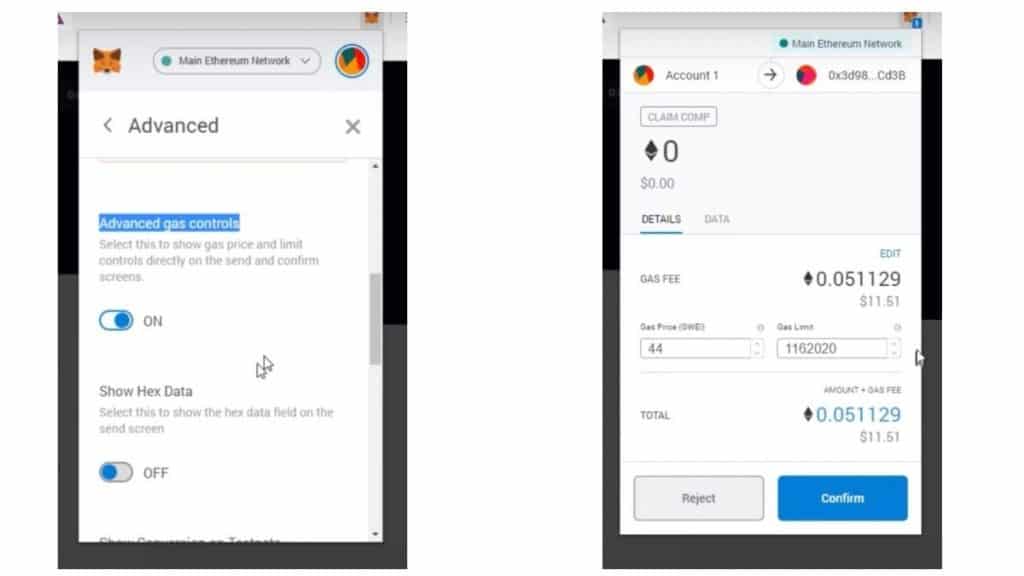
This enables you to save more money on gas fees. Now, when you send something, you can type in the gas prices that you would see on an Ethereum gas station.
It’s sort of like Unleaded and the Premium gas at a car gas station.
This little trick alone can save you some money on Etherium gas prices. Another idea is to wait and see if the prices drop. Maybe in the middle of the night, gas prices will be lower.
Another idea to save cash on gas prices is to use the Tx Calculator button on blocknative HERE and manually type in low gas prices. Then you can see how many seconds it will take.
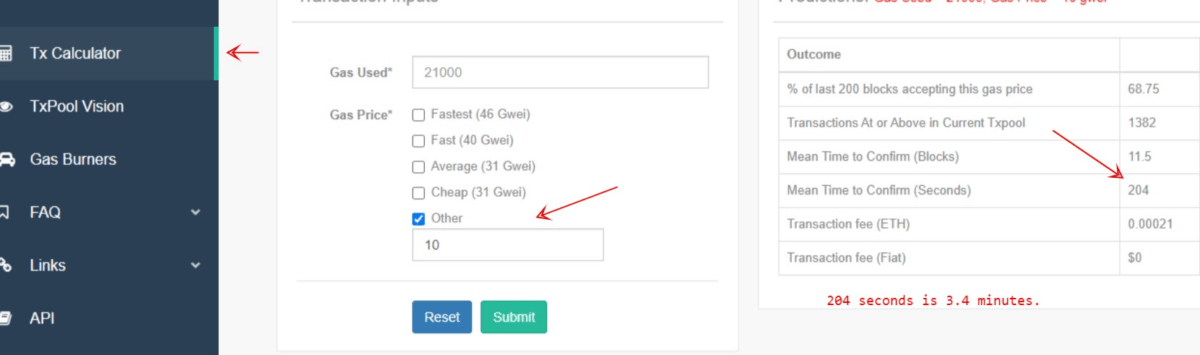
Then use a tool like this to convert the seconds to minutes. By using the Tx Calculator, your transaction might take longer, but you will save money.
Ethereum Layer 2 Guide: Using Base, Arbitrum, and Optimism to Pay $0.01 in Fees
Another way someone can reduce gas fees is by using a second layer.
There is a crypto card game I’ve been playing a lot recently called “Gods Unchained.” I created a blog post about my experience with it HERE.
It’s similar to the card game “Magic the Gathering” except that with this card game, there is a way to own your cards, and you can sell them on a marketplace.
You can also buy cards from other players, and it uses the Ethereum network.
Plus, the game is VERY fun.
The problem is the “gas fees.”
This means you could buy a card for $1, but to move the card, it could cost you $20, for example. The company that created “Gods Unchained” figured out a way to move their cards on Ethereum with NO gas fees.
The way they can do this is by using Immutable X. Immutable X is a second layer to Ethereum. Instead of submitting every transaction on Ethereum, Immutable X submits 1 BIG transaction with a few transactions in it.
Immutable X pays for that 1 BIG transaction instead of 1,000 tiny transactions. This way, everyone saves money, and it doesn’t slow down the network.
The Truth About Ethereum 2.0: Did the Merge Actually Lower Your Gas Fees?
Hopefully, gas prices will be reduced in the future with Ethereum 2.0.
The second version introduces something called sharding as well as proof of stake. I made a post HERE about the details on how Ethereum 2.0 is different than 1.0.
One of the challenges with a blockchain is how it scales. As the blockchain grows, the distributed ledger technology grows as well.
As I’m writing this, the Defi blockchain is close to 150 GB. One way to scale is by sharding. Thinking of sharding like a slice of pizza rather than the whole pizza.
Instead of a node recording all the data on the blockchain, each node only needs a slice of the data. This means transactions can be quicker, use less energy, and be better for everyone.
Another exciting concept with Ethereum 2.0 is something called proof of stake.
The traditional way a miner gets Etherium is with proof of work. A miner’s computer solves a complicated math challenge, and they get rewarded with a Bitcoin.
Proof of stake is the same thing, but instead of a computer solving the problem, someone would use Ethereum to do it. You can learn more about how they are different from this post HERE.
One of the major benefits of proof of stake is that it’s better for the environment. In order for someone to take over the network, someone would have to own 51% of the Ethereum being staked.
This would be so expensive, and harder to do than controlling 51% of the computer power.
Crypto is very exciting and risky, so it’s not a bad idea to diversify.
One way to do this that I’m a large fan of is affiliate marketing. You can do it anywhere in the world, anytime, around your schedule, in nearly any niche, with very low startup cost, and have a ton of fun.
I’ve been at it for 15 years, and I’m sharing the system I’m really excited about HERE.
I hope this article on why Metamask fees are so high was helpful to you. Bye for now.