

This post was originally published in [2021] and has been fully updated for 2026 with new data and tools
Most people think crypto requires a massive investment, but the VeBetterDAO has changed the game.
If you’re wondering how to earn B3TR tokens in VeBetter app, the answer is simpler than you think: just live your life.
From logging your morning coffee in Mugshot to tracking your steps in ST3PR, every sustainable action now translates into blockchain-verified rewards.
In this 2026 update, I show you how to maximize your daily earnings and which “X-to-Earn” apps are currently paying out the highest multipliers.
| GM NFT Tier | Multiplier (Reward Weight) | 2026 Upgrade Cost (B3TR) |
| L2 – Moon | 1.5x | 5,000 |
| L4 – Venus | 8.0x | 20,000 |
| L6 – Jupiter | 50.0x | 90,000 |
| L10 – Galaxy | 1,500.0x | 12,500,000 |
Keep reading, and I’ll do my best to simplify everything. I’ll explain what this crypto project does, why it’s needed, and some challenges it faces.
🌱 B3TR Reward Calculator
Estimate your weekly B3TR based on your GM NFT Tier.
Vote2Earn Strategy 2026: How to Maximize B3TR Payouts in the VeBetterDAO Ecosystem
Daily Money…
- Take a photo of yourself using a reusable coffee cup.
- Take daily step goals or walking instead of driving
- Local litter clean-ups
- Use green public transit or an electric vehicle
- Look out for Bikademy for cycling or GronCard for shopping
Passive Money…
- When you vote, you earn. Every week vote on which apps deserve the biggest B3TR pools
- You can swap your B3TR for VOT3
GM NFT
- If you hold GM NFT in your Veworld wallet, it multiplies your rewards.
- There are 10 levels. Level 2 is 1.1x boost.
- You can upgrade your NFT by locking it and thus increasing your earnings.
Staking
- Following the Stargate upgrade in 2026, Vechain has a better staking program.
- Some pools allow you to stake B3TR to earn more yield.
VeChain Evolution: How the 2026 Hayabusa Upgrade Fixed the 2021 VTHO Inflation Problem
In 2021, it was a corporate-only supply chain tool. They used the blockchain to track packages and stuff. There were VET Vechain Tokens and VTHO Vethor Tokens for corporations.
In 2026, it moved into a Business-to-Consumer system as well as tracking packages and added more tokens.
- B3TR – You earn this by doing green energy stuff.
- VOT3 – You can vote and earn rewards.
Plus, businesses want to look good for going green. So the blockchain is not just tracking boxes like in 2021.
The B3TR tokens you can earn doing green shit can be swapped for VET.
This way, corporations can trade the VET for the B3TR to prove they were green for their reports.
It’s a little like the carbon credit system I wrote about, where if you have a ton of green trees, you can sell the carbon credits to companies that use them to offset their dirty pollution habits.
Instead of trees, they use people who do green stuff. Make sense?
In 2021, this whole Vechain was proof of authority, where only 101 vetted masternodes could process transactions.
In 2026, it’s a proof-of-state system, and normal users can process transactions. In the old days of 2021, you needed a corporate partnership to be a validator.
Now in 2026, if you have 25 million VET and hardware, you can jump in.
To combat inflation, only people who stake and participate in Stargate get the reward pool. In 2021, it was more passive.
In 2026, there are WAY more users, about 5 million active addresses. In 2021, when Vechain started, there were 200K to 900K at the end of the year.
So, the project sure has grown!
Understanding VeChainThor 2.0: The Layer-1 Blockchain for Real-World Assets (RWA)
Vechain Thor is the name of the blockchain.
What makes Vechain Thor different than other cryptos is it’s focused on physical products and tracking them. These physical products can be anything, such as Barbie dolls, medicine, and even hair wigs.
How it would work is that the physical products would have a code (like a QR code). These codes will allow them to be tracked through the entire process of being sent to a physical location.
All these physical products are organized, tracked, and it’s more secure because it’s on a blockchain!
It was initially launched in 2015 on the Ethereum blockchain. In 2018, the team behind the project wanted their own blockchain, and they created Vechain Thor.
There are 2 tokens to this blockchain: the Vechain token (VET) and the Vechain Thor energy token (VTHO).
The VET token is used for transactions between 2 businesses on the platform. The VET token is also used to run an authority node.
Basically, someone needs VET to create VTHO tokens. Also, the VET token has a fixed supply of 86.7 billion.
The VTHO tokens have a lesser value and are used to pay for transactions and start smart contracts.
70% of VTHO used in each transaction is destroyed, and the 30% remaining is used to pay the authority nodes to enable the transactions on the blockchain.
In case you’re thinking about running an authority node, it’s VERY expensive.
You need 25 million VET to run this node. At the time of this blog post, it would cost 2.9 million dollars. Also, that 25 million VET needs to be locked up to run the node.
If you count all the nodes that have locked up VET, it would be 2.5 billion, which is (out of circulation), and this reduces the supply.
Oh, and there are more nodes that lock up VET, and this reduces the supply EVEN more. That 86.7 billion supply cap doesn’t seem so large.
If I haven’t confused you enough already, there are MORE nodes.
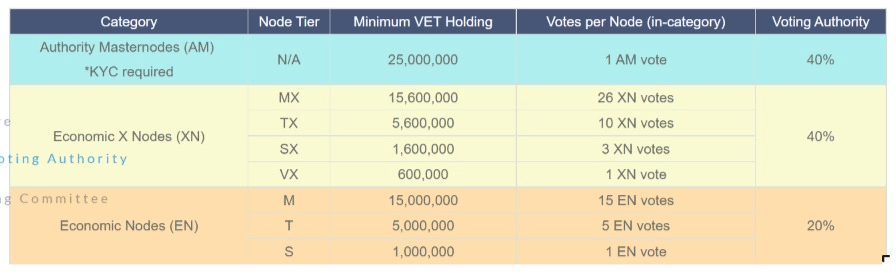
You might be wondering why someone would want to run an economic node? The benefit is that it also generates a smaller amount of VTHO, and you can vote on things.
Plus, not everyone has a few million dollars of cash – maybe this is why they created these smaller nodes.
The Real-World Purpose of VeChain: How Blockchain-Verified Sustainability Saves Companies Money
Supply chains for products can involve many countries.
Just take the iPhone that is designed in California. Then Apple purchases parts from 43 countries on 6 continents. Then sends the parts to factories to create the phone, and then ships the phone around the world to be sold.
You can click on this link HERE to learn more about this crazy supply chain.
Next, you have counterfeit goods, which are a huge problem. In 2020, Amazon.com destroyed over 2 million counterfeit items. You can read more HERE.
I have to mention there are LOTS of fake reviews on the site, and you can even buy reviews.
There is an issue with trust in many supply chains.
What crypto can do well is help with trust.
One example is Legos.
Yeah, there are LOTS of counterfeit LEGO sets, and sometimes these toys are worth a lot of money. How does a retail toy store (they are rare) know that the genuine product they ordered is the real one?

Vechain can be the answer.
What Vechain can do is track the item from the genuine factory all the way to the retail store. Everyone can see it on the blockchain.
Every product would have a scannable code, such as a QR code. This code would get scanned at each stage of transportation and be entered into the blockchain. Cool right?
You could do this when ordering wine. Pull out your phone at a restaurant and verify the wine came from the right vineyard.
VeChain (VET) Pros and Cons: Why Sustainability Use-Cases Beat Speculative Hype
Vechain has a very unique idea, but ideas are worthless.
The only thing that matters is execution!
How does it handle the real world? You might be wondering how many companies are using the technology?
There are at least 39, and HERE is a list of them. One of the most interesting companies that uses Vechain is Mycare.
Mycare is used to help with Covid 19, and Viking Line cruise ships use it.
Oh, and Walmart (the China division) uses them, and the same with BMW. The problem is nobody knows how much these companies are using the technology and “how helpful it is.”
Let’s talk about some of the negatives of this project.
One of the negatives is that someone can easily copy the idea and do the same thing for less money.
Also, some companies may want to develop their own blockchain and keep all their data on it.
The third negative is that the project seemed to lose focus. Instead of focusing on being the BEST at being a supply chain blockchain, they started to develop dapps, ICOs, and even NFT’s.

The fourth negative I see is that their whole token system is not simple.
It took “some time” to somewhat wrap my head around it.
If something is too complicated, most people just pass on it.
The fifth negative is that they are a Chinese blockchain project. The challenge with being a company from China is that there is some controversy that the Chinese party OWNS the companies in China.
You can read more about this from this link HERE.
Crypto is more about decentralization, and China is about central control of everything; it does seem like a conflict of interest.
Oh, and who can forget about China cracking down on Bitcoin!
Conclusion: How to earn B3TR tokens in VeBetter app
It’s hard to ignore Vechain, and it has some really good ideas.
Like many crypto projects, I’m very bullish on this project in the long run. It’s something I’m going to keep my eye on more.
If you’re interested to learn ALL the different passive income opportunities I’ve found with Bitcoin, you can check out this post HERE.
Finally, crypto is very risky with ups and downs.
It’s not a bad idea to diversify your income, and a wonderful idea is affiliate marketing.
You can do it anytime, anywhere, around your schedule, in nearly any niche, with very low startup cost, and have a ton of fun.
I’ve been doing it for 15 years, and I’m sharing a lot of my secrets for FREE HERE.
I hope this blog post on Vechain and Vechain Thor was helpful. Bye for now.