

This post was originally published in [2022] and has been fully updated for 2026 with new data and tools.
If you’re looking for a business you can run from a laptop, you’ve likely come across the “Rank and Rent” model.
But is lead generation legit when it comes to long-term passive income?
Unlike traditional affiliate marketing, lead generation puts you in control of the data.
Whether you’re selling to local contractors or national brands, understanding the 3 main business models is the key to longevity.
Plus, the good thing about lead generation is that it’s almost recession-proof due to many businesses needing more leads.
Lead generation can be legit, there is money to be made, and there are many different business models to choose from.
Keep reading, and I’ll share what lead generation really is, and 3 different business models for it. Plus, I’ll share which business model I prefer with the pros and cons of all of them!
Lead Gen Profit Calculator
Test Your Business Model Margins
What is Lead Generation? How it Drives Modern Business Growth
Lead generation really is helping businesses find paying customers. I know this sounds super broad, and it really is.
Affiliate marketing can be considered lead generation.
This is when someone clicks on a link and buys something; you will get paid. Advertisements can also be considered lead generation because you are generating a lead for another business.
There is the cost per acquisition marketing model. Lastly, you can generate leads for local businesses.
The reason for this post is that I wanted to document ALL the different business models with lead generation, and maybe it could help you choose an online business to start.
The Content Strategy: Building a Passive Lead Gen Model via Blogging
This is the business model that I’m currently using, and I’m a fan of it. You start with a blog post on a topic you want to learn more about.
Then you choose keywords that don’t have a lot of competition and get lots of traffic.
You write a post putting advertisements and affiliate offers in it. If you are advanced, you could set up a landing page, collect emails, and market affiliate offers through email.
The blog post can also be repurposed to get even more views, such as using YouTube, TikTok, LinkedIn, Medium, Quora, Substack, and more. Heck, you could even use press releases to get more traffic that I talked about HERE.
The good thing with this business model is it doesn’t take a lot of money to start, but it can be slower to earn money. Since I’m a HUGE fan of patience, this is the business model I’m a big fan of, and I currently use.

Plus, it’s really broad, and you can create content on anything under the sun. Maybe you want to learn about deep-sea diving. Well, I’m sure you earn money while documenting your journey.
Another “wonderful” thing about this business model is that it can be passive. This means you do the work one time, and it can pay you in the future.
There is no dealing with people over the phone, and it can be done anywhere in the world. Another challenge is that it does take education,
If you want to learn more, I created a post that shares 20 benefits a blog can provide, how AI can be used with it, and the exact steps to create one in this post HERE.
The main reason I like this business model is how simple it is. There aren’t a lot of moving parts, and this means fewer things can go wrong!
Scaling Fast: How the Paid Ads Lead Generation Model Works
As you can probably imagine, paid lead generation uses paid ads to generate leads. Google and Facebook are both very popular places for paid advertising.
You probably can get a better deal with lesser-known places, such as Bing ads. Bing, you know, the search engine Microsoft owns, but not many people use it!
The challenge with using paid ads is that it’s easy to spend yourself out of business. It’s also more advanced than using free methods.
What I would recommend is starting with the free ways, then using your profit to reinvest into paid advertising to accelerate your growth if you want.
Of course, you could start directly with paid ads, but I would recommend just starting VERY slow. Test the waters.
The advantage of paid ads is that it’s much faster to earn money, you’re trying to spend $1 dollar to earn $2 dollars.
With paid ads, there is lots of confusion. What about the split testing? Where to post the ad? How to craft an ad? How to know if it’s working or not?
Advanced right?
The good news is that this product HERE helps you jump into paid ads as easily as possible. Not only can it help craft the ads and test them, but it also does split testing and even tests them on all the platforms.
Really cool, right?
Remember to start slow and make sure you’re earning money.
You could set up a landing page and use paid ads to do CPC marketing. CPC, or Cost Per Acquisition, is when you get paid when someone fills out a form. Some CPC offers do pay a lot of money!
Another way (what I would recommend) is to go deeper. The money is made by going deep into any topic, right?
You could create a landing page and collect emails. Then, in 1 niche, you could market various affiliates and CPC offers, and maybe earn MORE money.
Plus, sometimes someone has to look at something a few times before they fill out the lead or make a purchase.
The greatest benefit of building a list is that you OWN the traffic. Plus other benefits such as….
- Can promote multiple offers
- Can contact someone WAY in the future
- Promote your other content
- Do list swaps
- Easier to get accepted into affiliate programs
- MUCH higher conversion rate
- Great for launching products
- Get valuable feedback
- Protects you from algorithmic changes
- More personalized marketing
The best news is that I’m giving away a bunch of free guides on how to build a list, tips on making a landing page, and even how to earn money from your list for FREE HERE.
Local Lead Gen: The “Rank and Rent” Model for Local Small Businesses
Local lead generation is just how it sounds. You are generating leads for local businesses.
Say you Googled a service, and it could be a tow truck in a town. All these websites would come up, right?
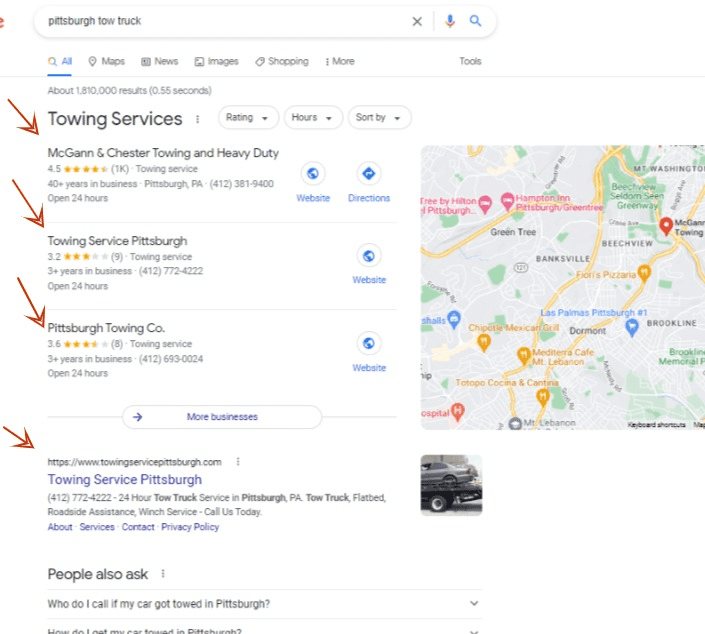
If you owned one of these websites, you would get a lot of traffic. Then on the website, you could have a phone number, and it could look like this.

If someone called that phone number, you could use something known as a call tracking number. Call tracking allows you to get information on who is calling, the entire conversation is documented, and you can forward the call.
On the website, you could also have a place for someone to enter their email.
The way this business would work is you would build the website first, and then you would rank it. Keep the website generic so MANY businesses could use it. Then, just like Costco, you would give local businesses a sample of the leads.
Show them you could put money in their pocket. Then, after some time (like 1-2 weeks), ask them to make a deal with you to sell them more leads. You want to give them a really good deal.
Plus, if the business doesn’t want to buy any leads, you could then sell your leads to another business in the area.
You might be wondering if it’s saturated, right? Well, there is a way to go into a small city with 5,000 population and there are TONS of niches to get into, such as cell phone repair or towing.
Sounds so simple, right?
Of course, I honestly think this is the hardest lead generation business model to get into. 1 reason is that there’s a lot more work that needs to be done.
There is a lot of moving parts and things can go wrong!
One thing that could go wrong is your research. You could build a website and get it to the top spot on Google, but local businesses don’t want to buy your leads. Maybe you get a website, and you get NO leads.
Still, if you have a few websites, then even if a few don’t work, you could still be in profit.
Another thing to think about is that you will need software to track and forward emails and calls. This company here allows you to get a local phone number and be able to forward it and look at the conversation.
You also need software for email leads and to be able to forward them, and HERE is one place. This website is amazing because you can do a lot for free.
Next is the training, and it can be very expensive.
There are MANY different places to get training, and one would be Chad Kimballs which you can find HERE. These courses are between $3,000 – $6,000.
The last thing to think about is that if you’re going to rank a website organically, you’re going to have to create good content about the topic.
If you have NO interest in (for example) towing, you’re going to have to write about a bunch of towing stuff to get it to rank.
Oh, and you do have to manually contact business owners and make deals. Plus, you are going to have to track everything, so there is more hands-on work.
Final Verdict: Is Lead Generation the Right Business Model for You?
I’m a big fan of being practical and positive. Not to be a Debbie Downer, but things usually take longer than we expect, right?
Knowing this, I recommend picking a business model you enjoy FIRST. This way, you are more likely to continue doing it even if you don’t earn a lot of money.
It’s the same with blogging or lead generation. You want to pick a niche that you want to write content about to rank and get leads.
If you’re forcing yourself to create content on boring shit you have NO interest in, then you’re more likely to quit. A hard truth is that it takes time to rank something organically in Google; it could take 8 months.
You also have to beat the competition.
No matter what business model you choose, it’s a good idea to stick with it for a long time.
Another business model, which I’ve lately been addicted to, is microstock. This is where you post photos, videos, music, and even illustrations, and if someone uses it, you get paid.
It’s actually very fun, and if you want to learn more, I created a post about it HERE.
I hope this post on lead generation was helpful. Bye for now.