

Most of us grew up building worlds out of plastic bricks, but for a select few, the clicking of those bricks is the sound of a paycheck.
While it sounds like an urban legend, finding a legitimate work from home job as a Lego set tester is possible if you know where to look.
Here are 3 ways.
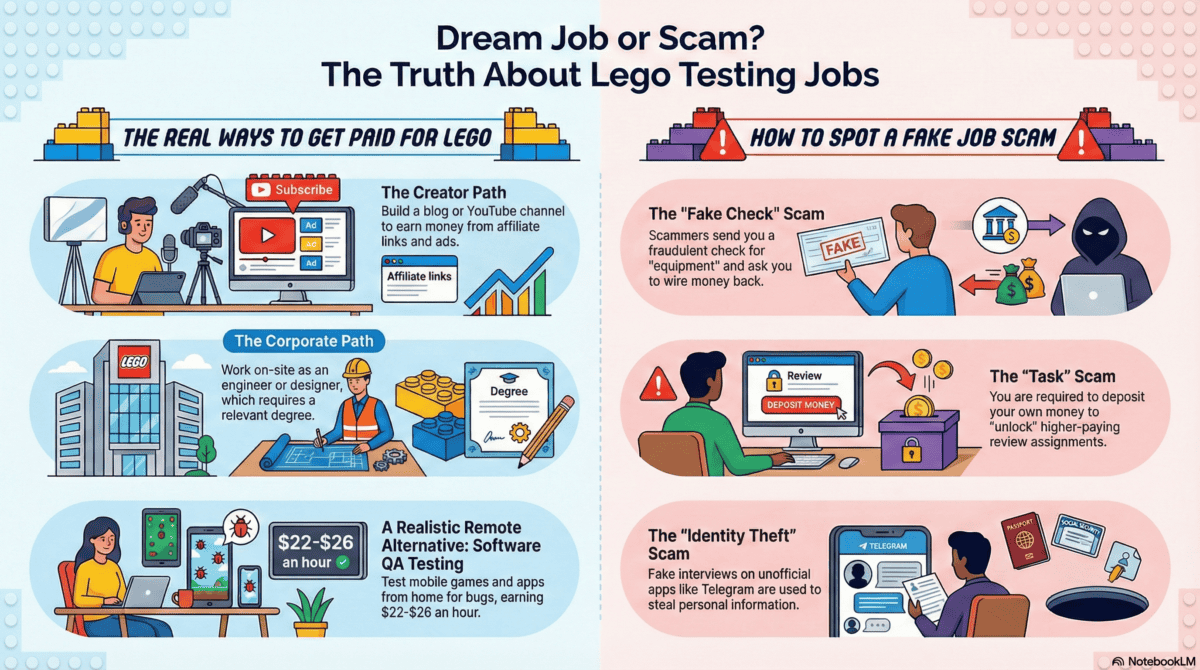
- Creator Path (blogging, YouTube, and affiliate marketing) to work from home, or the Corporate Path, which requires a degree in Engineering or Product Design and is based in cities like Denmark or Boston.
- Watch out for fake check scams (sending you money for equipment), task scams (paying to “unlock” work), and identity theft using unofficial apps like Telegram.
- Another idea is Manual QA Testing for software or mobile games. These roles often pay $22–$26 an hour and allow for work-from-home.
Keep reading, and I’ll go over 2 ways to get paid to play with LEGO, 3 ways to spot a scam, and a similar work-from-home job playing with video games.
🧱 Brick-Ready Quiz
Do you have what it takes to be a Remote Lego Set Tester? Let’s find out!
Lego Affiliate Program Review: How to Get Paid to Review LEGO Sets
The creator path is the easier one.
Basically, you’re creating content around LEGO using the written word, video (probably better), or audio (hard).
Lego does have an affiliate link HERE. There are 3rd party places, such as Rakuten Advertising, that also has it.
If someone clicks on your link and purchases something, you get paid. Plus, you can earn money through other methods such as advertisements, other affiliate offers, brand deals, and more.
If you want to get into LEGO, then something like this HERE could be a great idea to organize the pieces.
The last thing you need is to accidentally lose a piece, right?
The advantage
- Lots of flexible
- Work from home
- Freedom
- Can have a lot of fun
- OH, and you may be able to get a free LEGO set
Disadvantages
- You could earn nothing
- Your family could think you’re crazy
- It takes time
The good news is that there are different business models.
Honestly, I do it all, meaning short videos, blogging, Substack, long-form videos, and I used to do Podcasting.
I would recommend starting the difficult way.
Yep, buy a domain and build a website. Why? You own it. Then start blogging and try to get traffic from the search engines.
Also, use your blogs to create YouTube videos, sprinkle in some short videos, Pinterest, and this is what I do and recommend.
You can do it anywhere, anytime, in any niche, such as LEGO, have tons of fun, and you can earn money with it.
If you want to learn more about blogging, I wrote a post HERE that shares 20 benefits and 10 steps to start one.
How do you get Free Lego Pieces as a Creator
If your YouTube channel, website, or other platform you use, such as Instagram, gets honered you could recieve Review sets before they are released to the public.
The catch you probably need lots of followers and a long history of content around LEGO to be accepted. So sadly, it’s not easy.
You would apply to the LEGO Ambassador Network HERE.
If you see an ad for a Lego tester at home earning $500 a month, be skeptical because it may not be legit.
📏 Life-Sized Brick Calculator
How many bricks to build a wall?
How to Spot Fake LEGO Tester Job Scams: 3 Red Flags to Watch For
Sending you a cash scam
Sending you lots of cash ($2,000) to buy your testing equipment (camera, sets, table) for a job. This may sound great, but be careful!
Here is the scam….
Someone sends you a realistic-looking digital check. You deposit it, and it clears. Then you are asked to send ($1,500) through an app to the job.
Doesn’t this already look fishy?
3 days later, the bank realizes the check was fake, you lose $2,000, and the scammer gets $1,500.
Crazy right?
Task scam
There is an ad to review 20-40 LEGO sets a day to earn an extra $500 a week.
The first day, you get paid $20, but to unlock a higher level, you have to deposit money.
Once you deposit a large amount, the job disappears!
Identity scam
An ad says that it’s doing interviews through Telegram or WhatsApp.
You give them personal information, and you don’t get the job.
The problem is that they have your personal information and can sell it or steal it.
You might be wondering why someone would want to create a fake job for a LEGO tester.
- You could hand over sensitive information that someone can sell or steal. You know identity theft.
- Money laundering. Believe it or not, by having you reship LEGO sets, they could be using you to move stolen goods, possibly purchased with credit cards.
- Steal your money. If the job requires you to pay money, that is a red flag.
There is a real job for a LEGO tester, and it’s VERY hard to get!
LEGO Corporate Careers vs. Remote Testing: Which LEGO Job is Right for You?
A corporate tester sadly does not work from home.
You would work out of one of the main cities for lego such as..
- Richmond VA
- Denmark
- Boston
- London, UK
- Shanghai, China
- Monterrey, Mexico
- Nyíregyháza, Hungary
A corporate tester is also a more serious role.
It’s just not playing with LEGO. You’re doing things such as….
- Stress testing
- Bug reporting
- Ensuring instructions are accurate
- Ensure it works
The job may require a degree in Engineering or product design.
The pay can be $50,000 to $100,000+ and higher.
5 Steps to get a job as a Corporate LEGO Tester
Step 1 – Earn a relevant degree in Engineering, Product Design, or Quality Management.
Step 2 – Gain Quality Assurance in any industry to find bugs, test items, and follow the system.
Step 3 – Build a Portfolio to get your foot in the door.
Step 4 – Monitor the LEGO careers page and apply when there is an opening.
Entry-Level Software QA Jobs: The Best Remote Alternative to LEGO Testing
The good news is that there are similar jobs to a LEGO tester that can be legit.
One idea is software testing. You know testing mobile games and shopping apps for large companies.
The technical name is “manual QA tester,” and this role tests the product just like a customer. You’re trying to find glitches and errors before the public.
The good news is you get paid to play video games
Other things you could do are..
- Detailed reporting
- Hunting for bugs
- Following a set of instructions
- More testing to ensure that after the fix, it still works
Some jobs just require a high school diploma. You should also be familiar with bug tracking software.
You need extreme attention to detail, you’re curious, and think about how the tool might break, then try to break it.
Oh, and good communication, explain complex stuff in a simple way.
Pros
- Work from home
- Low barrier to entry
- Seeing real feedback from your work
Cons
- Usually contract-based
- Highly repetitive (think of a grindy video game)
- Can include tight deadlines (pressure)
The pay could be around $22 to $26 an hour.
Usually your paid per bug found or paid per test cycle completed.
You might be wondering how to find these work-from-home jobs that are legit. I would highly recommend this place HERE.
The main thing is they vet each job to ensure it’s not bullshit or a scam. Plus, they have a massive list of legit work-from-home jobs to choose from.
They even help you get the job.
It is a subscription service, but it’s worth it. Oh, they have been around for 19 years, too.
Conclusion
A while ago, I went to a class on testing websites and apps.
All I had to do was give my honest opinion, and the pay looked good. The person doing the class was making some great cash.
So, I signed up and took the test and interview, and passed.
When I actually got to the website, there were NO jobs available.
The moral of the story is that there is bullshit out there, and some work-from-home jobs are real. My last one was VERY cool.
For more on how to find a good, legit work-from-home job that is a good fit for you, I wrote a post HERE that goes over 10 steps.